by Name
Posted on Dec 08, 2025
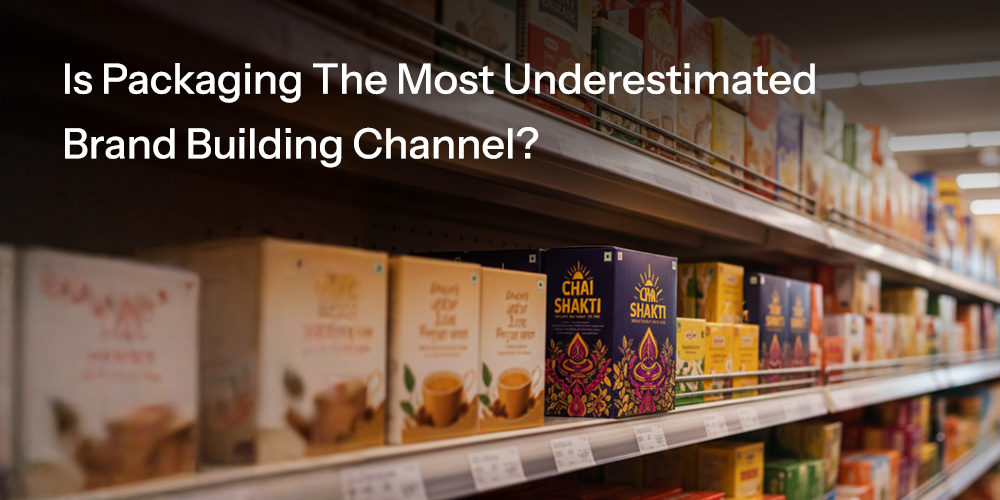
In the rush to chase digital performance, many brands forget a simple
truth. Packaging is the one brand touchpoint you can be almost certain every
paying customer will see, touch, and live with. Not for three seconds. For
days. Sometimes weeks.
That’s why packaging is beyond design. It’s about marketing. Quietly,
repeatedly, and in the moments where decisions are made and re-made.
For FMCG, food, personal care, and D2C, the pack does several jobs at once.
It reassures first-time buyers, signals value, creates memory cues, and sets
expectations for the experience inside. When it’s done well, it reduces cost of
performance marketing because building trust becomes easier. Here are 8 reasons
that make packaging one of the strongest brand-building channel.
1) Packaging reduces perceived
risk
Most categories sell parity at the functional level. A shampoo promises
softness. A biscuit promises taste. A protein bar promises nutrition. The
shopper still has to choose with limited attention and limited proof.
This is where packaging becomes a trust shortcut. Hygiene cues, clarity of
information, ingredient disclosures, and visual discipline all help a buyer
feel safer about trying a brand once. Research consistently links pack design
quality and hierarchy to how shoppers process brands and recall them later.
These designs are famous because they made choosing easier.
2) It’s the only media
customers keep
Unlike paid media, packaging doesn’t disappear after a campaign ends. Once
the unit is manufactured, it delivers impressions without another rupee spent
on reach. Not free in absolute cost – printing costs money – but free in incremental
media buying.
A jar that sits on a kitchen counter, a pouch in a tiffin bag, a box in an
office drawer. These are repeated brand exposures that performance platforms
cannot replicate at the same cost per view.
3) Packaging creates pricing
power (or destroys it)
Pricing is rarely decided by logic alone. People infer value through cues
such as materials, closure quality, label craft, typography discipline, and
whether the pack looks planned or patched.
In India, where discounting can become the default lever, packaging often
functions as the fastest path to premiumization without changing the core
product immediately.
Compare how premium Ayurveda or beauty brands present themselves (texture,
color restraint, structured labeling) versus mass brands that rely on loudness.
One invites higher willingness to pay; the other invites bargaining.
Also, evidence from Indian consumer research shows packaging influences
purchase decisions and even willingness to pay a premium in packaged foods
among young consumers.
4) Packaging builds memory
through distinctive cues
Brand memory is not built only through campaigns. It’s built through
repeated encounters with the same recognizable cues.
Color systems. Iconography. A consistent hierarchy. A mascot or
illustration style. Even the shape of a pack. When these codes repeat across a
portfolio, your brand stops being a product and starts becoming a category
default.
This is why the biggest FMCG players treat packaging as a brand asset, not
a project.
Consider Paper Boat. The brand is selling nostalgia through illustration
language and storytelling. The pack carries the emotion even before the first
sip.
5) Retail and marketplaces
reward clarity
Retailers want rotation and fewer queries. Marketplaces want thumbnails
that convert. Customers want reassurance without work.
Great packaging checks all these boxes. It makes the selling ecosystem
smoother through better shelf readability, fewer misunderstandings and clearer
product understanding. That can improve retailer confidence and reduce friction
at the counter.
6) It fuels word-of-mouth
For D2C brands, packaging often becomes the first physical moment of truth.
A product can be excellent; the unboxing experience can still make it appear
cheaper. These experiences often fuel word-of-mouth through social channels.
Unboxing content is not guaranteed, but good packaging increases the probability
of share-worthy moments, because people like sharing things that make them look
smart, tasteful, or ‘in on something.’ Branding experts are of opinion that
such D2C experience frames packaging as a core trust-building touchpoint.
7) Packaging is your physical
UX
When packs communicate poorly, it leads to claims, complaints and unwanted
feedback.
Clear usage instructions, clean hierarchy, legible ingredient panels,
storage guidance, and honest claims reduce avoidable complaints and returns.
In India, this matters more because usage contexts like climate, storage
conditions, language comfort, and household decision-making vary widely.
8) It’s one of the quickest
differentiation levers
Product parity is real in consumer packaged goods. Changing formulation
takes time. Changing supply chain takes longer. Packaging sits in a sweet spot.
It can transform perception faster than most other levers, but only if it is
driven by strategy. .
Is your packaging building the
brand?
Ask these questions:
If most answers are negative, then your packaging is costing you twice. Once
in printing, and again in media spend to compensate.
If you are building a new product, planning a redesign, or struggling with
premium perception and conversion, packaging is one of the highest-leverage
places to intervene.
At Purple Phase, we approach packaging as way do drive brand
strategy, design, compliance, and buying behavior. So the pack sells even
when your ads are not running.
If you want a packaging partner that thinks beyond ‘make it look premium’,
write to us at info.purplephase@gmail.com
Prerak Shah: +91 9327009400
First Floor, Bungalow No.2,
Opera Society, Part-2, Besides Aagni Flats,
Opp. Annapurna Hall, New Vikasgruh Road,
Paldi, Ahmedabad - 380 007.
Gujarat. India.